


Revisiting One Hand Clapping
-
Andrew Biswell
- 1st April 2026
-
category
- Blog Posts
A closer look at the first Joseph Kell novel, published in 1961.
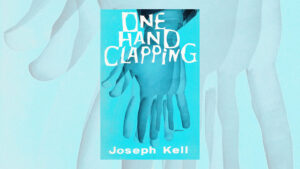
When Anthony Burgess was struggling to establish himself in the literary world in the years before the publication of A Clockwork Orange, he wrote a strange comic novel that stands apart from most of his other work.
Although One Hand Clapping has little in common with the futuristic dystopias for which Burgess is best known, it is one of his most successful satirical novels, animated by a witty and energetic first-person voice.
The narrator is Janet Shirley, a tough working-class woman in her twenties from Bradcaster, a fictional town in the north of England. Janet is married to Howard, a melancholy used-car salesman with a photographic memory. They are both avid readers of the Daily Window, a tabloid newspaper whose pages are said to be filled with ‘a lot of lies and tripe.’
Howard is accepted as a contestant on Over and Over, a TV quiz show which promises to pay out thousands of pounds in prize money. The resulting discussion of popular culture allows the novel to articulate its more serious points about mass media in the 1960s. After Janet and Howard win the jackpot in the quiz, their lives are disturbed by a meeting with a bohemian poet called Redvers Glass (whose looks are ‘smashing’, according to Janet). The fictional Glass seems to be based on Dylan Thomas, the Welsh poet who had a rather uneasy real-life friendship with Burgess and his first wife. His poetry is no less bombastic than the work of Thomas, whose early death in 1953 had been hastened by alcohol abuse.
As a piece of social reportage and cultural criticism, One Hand Clapping can be very sharp indeed. In the second volume of his autobiography, Burgess writes that he set himself the task of writing in the cheerily demotic style of the Daily Mirror, the newspaper favoured by Lynne (the book is dedicated to Hazel, her sister). The same newspaper would later publish a furious denunciation of Burgess when he decided to leave England for tax reasons shortly after his second marriage in 1968.
One of the objects of the novel’s satire is the fast food which had come into fashion shortly before it was written. Janet’s kitchen is exclusively stocked with tinned and frozen food, especially fish fingers, cans of corned beef, and steak and kidney puddings. Returning to England after a trip to America with Howard, she says: ‘I made spaghetti on toast, a good English meal after some of the foreign muck we’d had.’
First published in 1961, One Hand Clapping was the first of two books published under the name ‘Joseph Kell’, a pseudonym adopted by Burgess for this novel and Inside Mr Enderby. The change of name was proposed by his publisher, William Heinemann, in response to his most productive phase as a novelist in 1959-1961, when he wrote six novels in just over a year. His editors at Heinemann were worried about flooding the market with Burgess novels, but the nom de plume backfired when the British edition of One Hand Clapping, believed to be the debut novel by an unknown writer, was completely ignored by reviewers.
When One Hand Clapping was published in the United States in 1963, the critical response was more upbeat. The front cover of the Corgi paperback edition led with a question: ‘Why did this ordinary man allow money to drag him to the pit of despair and degradation?’ This is one way of looking at the book — but it overlooks the strong elements of comedy which are present throughout Burgess’s text.
One Hand Clapping is one of only two Burgess novels with a female narrator (the other is The Pianoplayers). In the case of Janet Shirley, her narration is slangy and full of lively colloquialisms. Watching a variety show on television on a Saturday night, she comments:
The singer and the comedian were doing a kind of final number in night clothes, with a big cardboard moon up above, and she was wearing a toreador jama, very snazzy. Then they finished with a close-up of her back teeth on the last note, and we had the commercials. Fivepence off fish cakes and threepence off Giant Size Splazz. Wait a bit longer and they’ll give them away.
The novel has always been popular among readers, especially in languages other than English, where it is often interpreted (rightly) as a satire against capitalism and consumerism. There have been translations into Swedish, Polish, Hungarian, German, Georgian and Turkish. A successful stage adaptation by Lucia Cox in 2013 was later revived in New York and Budapest. Francis Ford Coppola’s production company acquired an option in the film rights in 1999, but this lapsed before the film could be made. In recent years there has been renewed interest in further adaptations.
A new edition of the novel was published in February 2026 by Galileo Books, based in Cambridge. To accompany the print and e-book editions, an audio book was released in March 2026. One Hand Clapping is narrated by Becky Bowe, a graduate of the Manchester School of Theatre in Burgess’s home city.
The paperback of One Hand Clapping is available to buy from Bookshop.org.
Details of the audio book are HERE.