Object of the Week: the Chatsky Manuscript
-
Graham Foster
- 7th March 2017
-
category
- Object of the Week
-
tagged as
- Archive
- Burgess 100
- Chatsky
- Collections
- Object of the Week
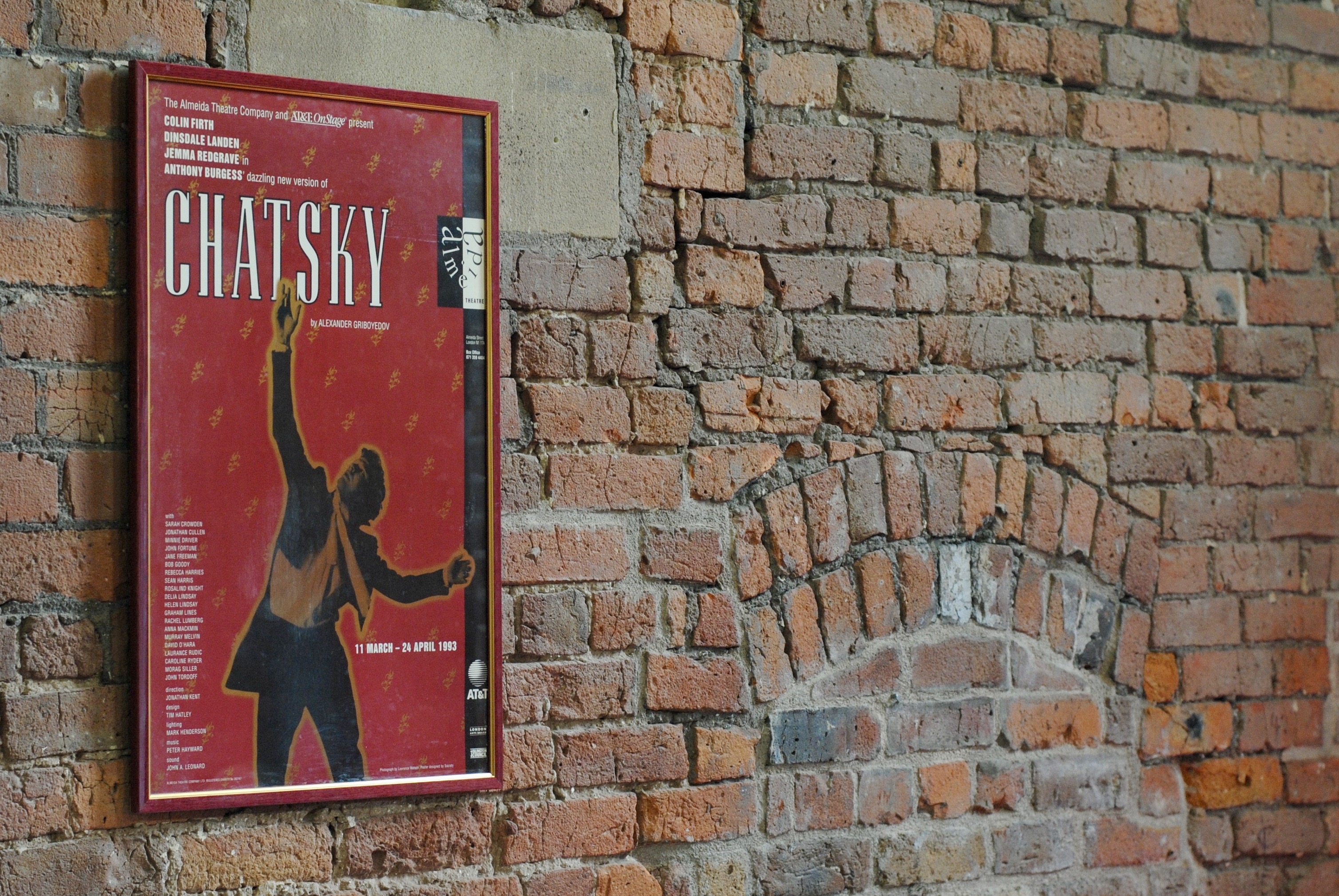
Chatsky, or The Importance of Being Stupid, a translation of Alexander Griboyedov’s Russian stage play Gore ot Uma (Woe Out of Wit), was part of an intensely creative period towards the end of Anthony Burgess’s life. He completed the translation around Easter 1991. The first performance took place on 11 March 1993 at the Almeida Theatre in London. This successful production subsequently went on a year-long tour to provincial theatres around England.
Burgess’s relationship with the literature, culture and language of Russia is most evident in his novels A Clockwork Orange (1962), Honey for the Bears (1963) and Tremor of Intent (1966), all of which followed his visit to Leningrad in the summer of 1961. He began learning the language before this trip, and became proficient as he was putting the finishing touches to his novel written in Nadsat (this being the Russian word for ‘teen’). Chatsky shows that his interest in the literature of Russia, and his linguistic ability, remained strong in the final phase of his literary work.
Burgess’s bold re-working of Chatsky owes a slight debt to an earlier English version by Joshua Cooper, who translated the play into free verse rather than the rhyming couplets which are found in Burgess’s adaptation and in the original Russian text. Cooper’s literal rendering of the play was, according to Burgess, ‘unactable’.
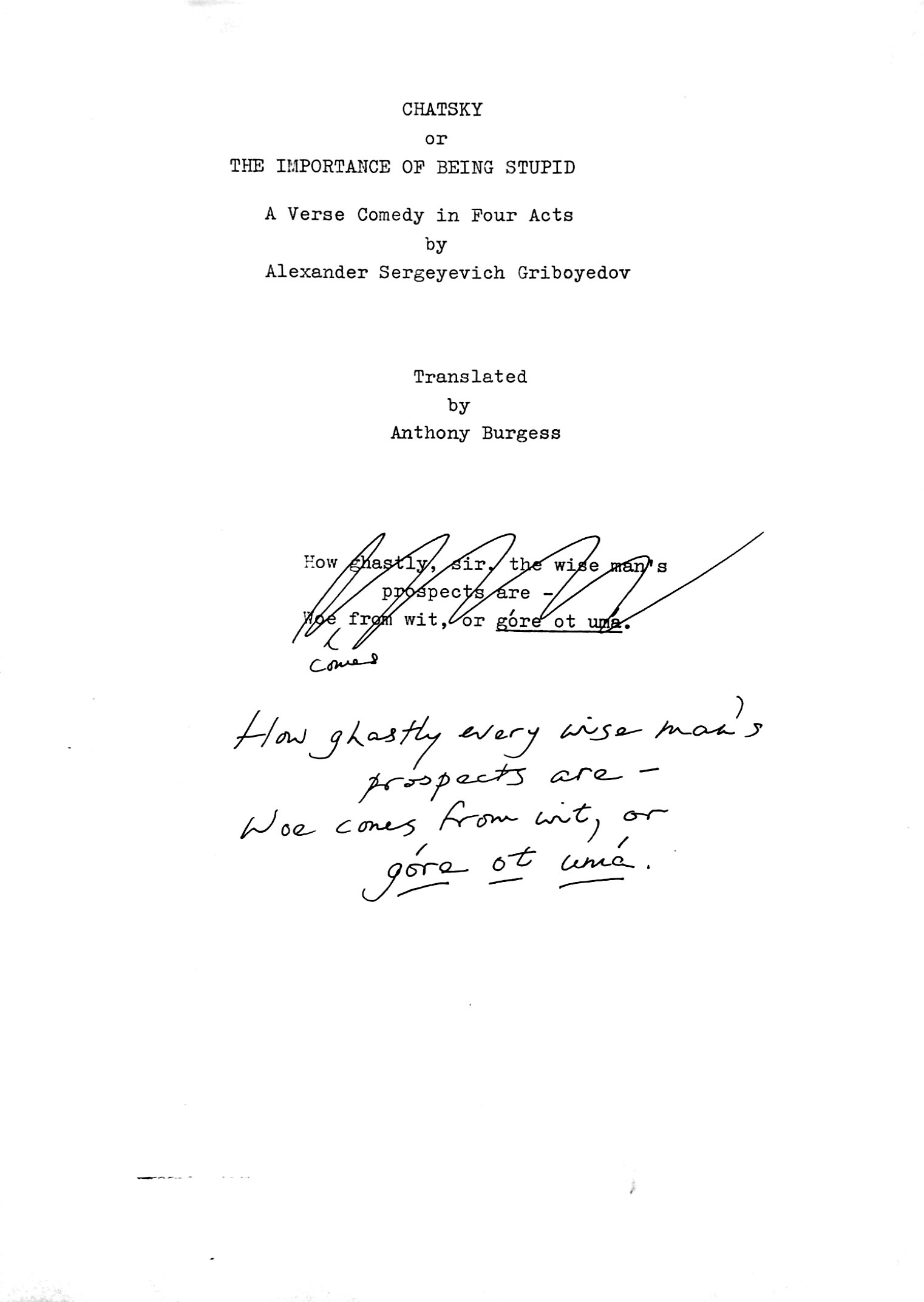
Griboyedov wrote Woe Out of Wit while he was working as a diplomat in the Caucasus and Persia (now Iran). The play was completed in 1824, but performances and publication were initially banned because of its criticism of identifiable people within the Russian court. It was not published in full until 1861, by which time Griboyedov was long dead. In the play, a satire of Moscow society, Alexandr Andreyevich Chatsky falls in love with Sophie, the daughter of his patron, Pavel Famusov. The greedy Famusov wants to marry off his daughter to a member of Moscow’s elite, but Chatsky values education and knowledge above money and social position. He has travelled the world, educating himself beyond the limitations of Moscow — but, on his return, his intellectual pontificating leads to a widely-believed rumour that he has gone mad. The play suggests that he is the only truly sane man within the society it depicts.
In Russian culture, Chatsky is regarded as a difficult role, which requires a virtuoso actor with great stamina and the ability to memorise and deliver long monologues. The part tests actors in similar ways to the role of Hamlet.
Burgess describes the play as a ‘comedy of considerable bitterness’, and it is easy to see why he wanted to translate it. Like Burgess, Griboyedov was something of an outsider in his home country. He spent many years living abroad, and the play’s theme of intellectual rebellion against a philistine society also occurs frequently in Burgess’s writing.
The first run of Chatsky at the Almeida Theatre in 1993 starred Colin Firth as Chatsky, Jemma Redgrave as Sophie, Dinsdale Landen as Famusov, Jonathan Cullen as Molchalin, and Minnie Driver (in her first London stage role) as Liza. It was directed by Jonathan Kent, who was joint Artistic Director (with Ian McDiarmid) of the Almeida from 1990 until 2002. Kent described Burgess as ‘one of the best things to happen to our theatre because the ability of language to inspire is what the Almeida is all about’. Although Burgess was already suffering from the lung cancer which would end his life, he was able to attend the opening night and meet the cast.
Burgess’s translations of Chatsky and Miser, Miser (his adaptation of the French comedy L’Avare or The Miser by Molière) were published in a single volume by Salamander Street in 2023.