


Burgess on the beautiful South
-
Andrew Biswell
- 2nd February 2026
-
category
- Blog Posts
Anthony Burgess often wrote about his love of the North of England. In this article, we consider why he was also drawn to the South.
One of the paradoxes of Anthony Burgess is that he was a proud northerner who longed for the culture and climate of southern Europe.
Born in Manchester at a time when the city was part of the county of Lancashire, Burgess wrote fondly about the northern place where he grew up. In Little Wilson and Big God, the first volume of his autobiography, published in 1987, he is nostalgic for the robust food of his boyhood:
Fish and chips are everywhere now but they are essentially a Lancashire matter, not even a national one. There are none like those that came out of the huge square seething vats of the Manchester chip-shops. Lancashire used to be famous for shops which provided an instant meal to take home — meat pies with gravy poured in hot from a jug, tripe and cowheels, above all fish and chips.
Burgess depicts Manchester before the Second World War as a Catholic city which is more Irish than English. His sentimental version of Lancashire is a place where the Reformation never really took hold. There is plenty of Friday-night boozing and guilty fornication in back alleys. London and the south of England, by contrast, are snooty, puritanical places with no real culture, where nobody talks to their neighbours and the water is too hard to make a proper cup of tea. In London, there is a distinct lack of tripe and cowheel pies.
If Burgess’s version of England elevates the north above the south, the reverse is true in his writing about the mainland of Europe. Thinking back to his wartime posting to Gibraltar (‘the extremity of the great Catholic Europe’) in Urgent Copy, he remembers being immediately drawn to the Rock:
Catholic baroque, the onion domes and the barley-sugar columns of the Moors, the soft and fictile humanism of the British. Could one imagine a stranger mixture? Yet it worked here; it contrived a harmony. I saw that I was falling in love. Being a Catholic, I had a place in the Corpus Christi processions of the Gibraltarians. The language of Andalucía slipped on to me as gently and as well-fitting as a coat.
After his marriage to Liana Macellari in 1968, Burgess lived almost exclusively in southern Europe: in Malta, Rome, Bracciano, Callian and Monaco. In the early 1970s, Burgess and Liana occupied an apartment in Trastevere, then a working-class district of Rome, and it is clear from his writing about the place that he felt completely at home there: ‘I have lived and written in other southern cities but only in Rome did I feel the essential dignity of writing books. Rome proclaims the importance of the artistic impulse: the city itself is the most massive work of art.’
He adds: ‘The food is fresh and simple and unsmothered in sauces. The coffee is the best in the world. I would perhaps be living there still if my landlord hadn’t trebled the rent.’
When he lived in Italy, Burgess insisted on his identity as a Mancunian, often introducing himself as ‘cittadino Mancuniense’. This loyalty to the city of his birth was not always well understood: some of his Italian friends believed that he was from Manchuria.
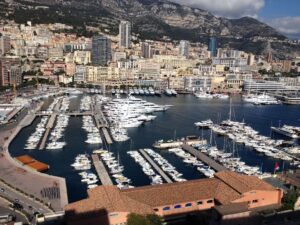
From 1976 until 1993 Burgess’s main residence was at number 44 rue Grimaldi in the Condamine district of Monaco. He completed many of his major works here, including Earthly Powers, This Man and Music, and The End of the World News. In an article from 1980 about the French Riviera, he writes:
To sip a Pernod on a café terrace and look lazily at the crammed shipping in the port while the sun beats is a solvent of even my chronic melancholia. To lunch off fish soup and baby octopus with a cool white wine of Provence does not really feel like dwelling in a vale of tears.
In another essay, in which he considers the wider culture of the south, Burgess commented that he had ‘learned to love the dirt, disorder, superstition, roguery, and original sin of the Mediterranean.’ When he travelled north to Stockholm in November 1981, it was a different story:
My wife had her handbag stolen three times in three weeks in Rome, and now carries her necessities around in a plastic shopping bag. In Stockholm, or Oslo, she can be sure that her car will not be Neapolitanly stripped or her camera snatched from a café table. The principles of honesty, obedience to the law, and the cult of personal integrity are deeply ingrained.
Yet Burgess makes it clear that Sweden — and northern Europe more generally — was not really to his taste: ‘Their streets are as clean as their houses. They do not resound with drunken song, as in certain southern capitals. Life is safe. Life is dull.’ For Burgess, Sweden and Norway were places of ‘blandness and blondness’ where there were no raucous pubs and even the television programmes lacked excitement. He ends his essay on Stockholm by declaring that ‘Life is probably better in Naples.’
We can also see Burgess’s prejudice in favour of the south in the novels he wrote after 1968. In Earthly Powers, the main character makes a spiritual journey from the south coast of England to France and Italy, before deciding to settle in a sun-kissed palazzo in Malta. Beard’s Roman Women is a love letter to the cheerfully lawless citizens of Rome. John Keats dies in ABBA ABBA after a revelatory meeting with the poet Belli in the Sistine Chapel.
In Byrne, his last novel, published in 1995, London is represented as a place of darkness and menace, full of rain-soaked streets and discarded rubbish. Wishing to escape from the hellish prison of northern Europe, the principal characters journey south to Venice, where they feast on meatballs and linguini, get drunk, and keep company with a female erotic novelist.
In summary, we can say that the North, especially Lancashire and Manchester, represents an authentic vision of England for Burgess. When he is writing about Europe, the compass is reversed, and he shows a strong preference for southern places such as Rome, Gibraltar and the French Riviera.
As a renegade Catholic who enjoyed eating and drinking, among other sensual pleasures, Burgess felt most at home in the South. Northern Europe was fine for a short visit, but after a few days he began to feel a strong yearning for the culture, food and warmth of the South.