


A Clockwork Orange
A Clockwork Orange is Anthony Burgess’s most famous novel and its impact on literary, musical and visual culture has been extensive. The novel is concerned with the conflict between the individual and the state, the punishment of young criminals, and the possibility or otherwise of redemption. The linguistic originality of the book, and the moral questions it raises, are as relevant now as they ever were.
- A Clockwork Orange
- A Clockwork Orange on film
- A Clockwork Orange on stage
- The Music of A Clockwork Orange
- A Clockwork Orange and Nadsat
- A Clockwork Orange and the Critics
- The Legacy of A Clockwork Orange
- The Podcast
A Clockwork Orange and the Critics:
A Clockwork Orange met with a mixed reception on its first publication in London in 1962. Many critics praised the inventiveness of the language, while voicing unease at the violent subject matter. When the Spectator praised Burgess’s ‘extraordinary technical feat,’ the reviewer (Julian Mitchell) was uncomfortable with ‘a certain arbitrariness about the plot which is slightly irritating.’ Robert Taubman, writing in the New Statesman, said the book was a ‘great strain to read’, though he praised Burgess for addressing ‘acutely and savagely the tendencies of our time.’ In the Times Literary Supplement, the anonymous reviewer was more critical, accusing Burgess of being ‘content to use a serious social challenge for frivolous purposes, but himself to stay neutral.’
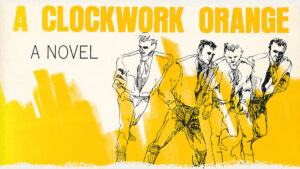
The book was better received by other novelists, with Kingsley Amis writing in the Observer that ‘Mr Burgess has written a fine farrago of outrageousness, one which incidentally suggests a view of juvenile violence I can’t remember having met before.’ Malcolm Bradbury reviewed the novel for Punch magazine in a more measured fashion. He wrote: ‘All of Mr Burgess’s powers as a comic writer, which are considerable, have gone into the rich language of his inverted Utopia. If you can stomach the horrors, you’ll enjoy the manner’. Roald Dahl simply called it ‘a terrifying and marvellous book’.
In the United States, the response to the novel was more positive. The Washington Post praised Burgess’s Joycean inventiveness and the brilliance of his writing, while the Berkeley Gazette claimed the novel ‘offers a frightening insight into the probable thinking of the violent young’. American reviewers were less troubled than their British counterparts by the brutality of the novel. The critic of Tulsa World noted that the ‘story moves along rapidly and keeps you smiling even while heads are being bashed and stomachs kicked.’
But the novel was not an instant hit with readers. The book sold slowly, despite the praise of writers such as William Burroughs and Roald Dahl. By the mid-1960s, the UK hardback edition of A Clockwork Orange had only sold 3872 copies, although the book was always more popular among American readers. As time passed, the notoriety of the book increased, fuelled by Stanley Kubrick’s 1971 film adaptation.
After the release of the film, Burgess became what he called ‘a major spokesman on violence’ and he was often asked to defend his book and Kubrick’s film, or to speak about violence on television and radio. In Britain, defence lawyers acting on behalf of criminals found it easy to blame the film of A Clockwork Orange for any crimes of violence, especially those committed by teenagers. Understandably, Burgess was unhappy about this. In 1972 he wrote: ‘What hurts me, as also Kubrick, is the allegation made by some viewers and readers of A Clockwork Orange that there is a gratuitous indulgence in the violence which turns an intended homiletic work into a pornographic one.’
Over time, Burgess developed a complicated relationship with his most famous novel. In 1986 he wrote: ‘I do not like the book as much as others I have written: I have kept it, till recently, in an unopened jar — marmalade, a preserve on a shelf, rather than an orange on a dish.’
But it would be overstating the case to say that Burgess disliked his own book. He held different opinions at different times in his life, but he returned to A Clockwork Orange on many occasions, adapting it as a stage play, writing articles about it, and writing another novel based on the reception of the film. In The Clockwork Testament, or Enderby’s End, Burgess shows the fictional poet Enderby dealing with unwanted fame arising from a film whose screenplay he has written, based on a religious poem by Gerard Manley Hopkins, the meaning of which has been distorted by vulgar Hollywood producers.
The novel version of A Clockwork Orange continues to be regarded as one of the masterpieces of twentieth century literature, and to inspire new generations of readers.